I work independently, which makes me a little suspicious of articles that conclude everyone needs someone who works independently. It's a remarkably convenient match between how the world works and how the author invoices.
In-house design, freelance support, and agencies solve different organizational problems. One specialist can sometimes get a focused project finished faster. Sometimes that person becomes the single queue for research, interface work, and developer questions.
Do you need someone for a project or someone inside the product?
When you're testing an idea and building a first working version, plenty is still moving. The structure changes after prototyping. Implementation exposes constraints. Some features get dropped. It helps when someone can move across stages without retelling the story to a new person each time.
An established product with continuous changes has a different need. Someone must remember why decisions were made, what still needs testing, and which constraints have accumulated. Each handoff to a new contractor requires some of that knowledge to be reconstructed.
A freelance product designer can work closely with a team for a long time. An in-house designer can be far from users and receive nothing but screen requests. I'd look at how the work will happen before choosing the label.
What one person actually gives you
My work on the published SVRTW project included the website and admin interface design, front-end implementation, responsive behavior, a code security review, and SEO recommendations. The point was to carry decisions beyond the mockups and see how they behaved in components, across screen sizes, and in different states.
The boundary matters. Another developer handles the back end, and the store is still in development. The illustrations show prototypes with test data. This project isn't evidence that I independently launched the entire store or delivered a sales increase.
It does show a real advantage of combining roles. When I'm implementing an interface, I don't need to explain a design decision to myself again in a chat. An implementation constraint can go straight back into the design for another check. There are fewer handoffs and fewer chances to lose the reasoning.
The day still has the usual number of hours. Combining roles doesn't mean performing them simultaneously.
Where an independent specialist becomes a bottleneck
Suppose a team needs new flows, user interviews, developer support, and component library updates every day. That's a hypothetical situation, but its constraint is simple: while one person is interviewing someone, they aren't answering a developer's question.
Urgency doesn't remove the queue. AI can speed up some production, but decisions, validation, and conversations still take attention. If several workstreams must move in parallel, the team needs enough capacity to handle them.
Competence creates another boundary. My scope can include straightforward back-end tasks such as forms, a CMS, and simple integrations. Payments, personal or medical data, regulated systems, and high traffic require specialist engineering and an independent review. Promising to handle all of that alone would be a stretch.
If you're unsure how many people the project needs, send me the product and the task. I'll look at the dependencies: what can move through one workflow and what needs separate expertise
What to compare beyond the rate
The rate is visible immediately. The cost of briefing, approvals, and lost context shows up later. I'd compare the options through a few questions.
| Question | What it clarifies |
|---|---|
| Is the workload ongoing or project-based? | Whether continuous availability is needed |
| Who makes product decisions? | Whether the designer can access the context |
| How many workstreams run at once? | Whether one person has enough capacity |
| Who supports the work after handoff? | Where knowledge and ownership remain |
| Which skills are needed besides design? | Whether the team has the right capabilities |
An agency makes sense when you genuinely need several disciplines and can coordinate their work. An in-house role helps retain context across a steady workload. A freelancer can fit a defined project or an ongoing engagement with agreed availability. None of those arrangements works automatically.
How to choose when everyone's portfolio looks good
Ask the designer to explain one decision. What did they know at the beginning? What changed after testing? Which parts did they personally handle? What belonged to another team?
I'd also look at the less glamorous parts: errors, empty states, data constraints. They show how far the thinking goes beneath the surface. Not every project needs to publish all its documentation. A collection of polished screens simply answers only some of the questions.
If you're bringing in a UX designer for research, establish access to users and analytics. Hiring someone to investigate a problem while promising access “later” builds a contradiction into the engagement.
Another useful question: what won't they do, and whom would they recommend bringing in? A clear boundary is more reassuring than an offer to cover absolutely everything.
When working through a lead agency or another contractor, agree on who consolidates feedback and who makes the decision. Otherwise, the client, project manager, and designer can end up working from different versions of the task. I won't use private client stories to make that point; someone else's internal process isn't material for proving myself right.
Where I come in
I can connect the product problem, design, and implementation within a defined scope. When the work outgrows that arrangement, the team needs to change, rather than the confidence of the promise.
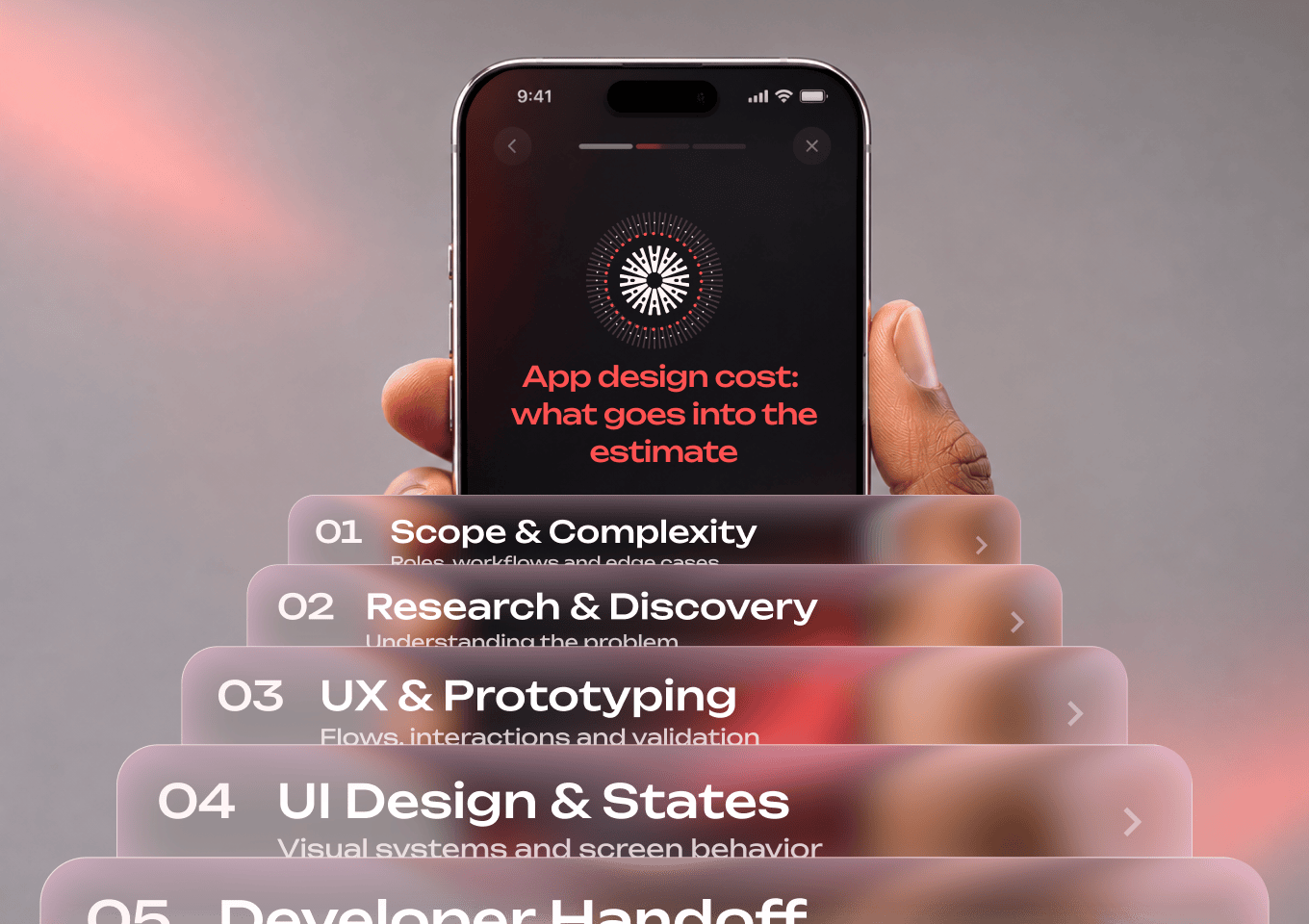
If the decision comes down to an estimate, see app design cost. If the scope itself is unclear, start with a website UX audit.
Send me a link and describe the next task. We'll look at what the product needs and who should own the work
Sources and limitations
The published SVRTW case study was reviewed in its Russian-language version on November 4, 2026: scope, development status, test data, and separate back-end development. The comparison reflects my approach. The parallel-workload example is hypothetical. No hiring outcome, savings, or delivery timeline is guaranteed.